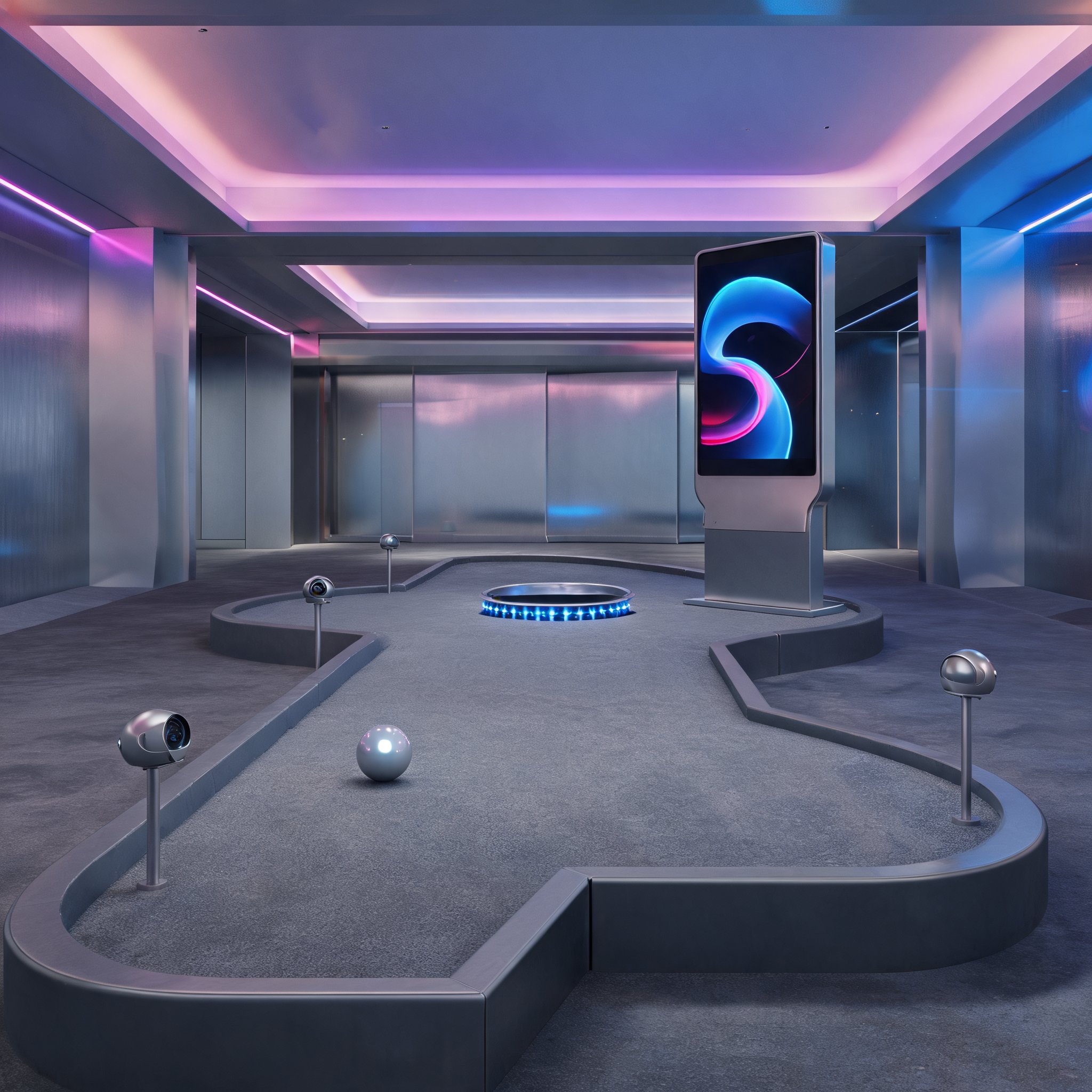
Holovis is not trying to reinvent mini golf. Its 360Golf brand instead adds automation, gamification and analytics to a format that visitors already understand, aiming to make the traditional putting game more competitive, more measurable and more repeatable for the competitive socialising market.
The platform’s foundation is automated scoring. Smart balls, tees and cups work with the HoloTrac scoring system to eliminate paper scorecards and act as a referee when competition is tight. Layered on top are gamified elements: SuperShots offer alternative ways to score, while Triumphs present awards and unlock new challenges. Bonuses, on-course games, player accounts, achievements, leaderboards and video celebrations give guests more reasons to compare results and come back.
Holovis says visitors can register at a kiosk, collect an assigned smart ball and begin playing with little explanation or staff involvement. That simplicity matters commercially. By keeping the front-end experience intuitive, the system is intended to let venue teams focus on hospitality, food and drink rather than explaining rules or manually scoring rounds.
Analytics move beyond the scorecard
Underpinning the experience is DeepSmarts, an AI analytics engine that gives operators information on player behaviour, seasonality, uptime and venue performance. Holovis says the data can help operators adjust promotions, target quieter periods or underserved groups, and increase dwell time and secondary spend. The company also says 360Golf can optimise capacity to up to 80 people per hour per course.
DeepSmarts also supports maintenance. 360Golf is designed for venue-level servicing, with a repairable approach intended to extend equipment life. If a problem occurs, Holovis says engineers can use the system to review what happened remotely and identify the issue. That support model is part of the platform proposition: operators buy not only holes and scoring hardware but also a connected system for managing play and resolving faults.
Flexible formats with a common core
360Golf is offered in several formats. Tech-only packages can be retrofitted into existing mini golf attractions; catalogue holes provide tried-and-tested designs; and fully bespoke courses can be developed for specific venues. Installation timelines reflect that range. Holovis estimates six to eight weeks for tech-only deployments, eight to 12 weeks for catalogue holes, and six months or more for custom courses.
The common core is the scoring and game platform. That allows a smaller venue to choose a more cost-effective course while still offering automated scoring, leaderboards and replayable game features. For multi-site operators, the same technology can support consistency across locations while allowing variation in theming, layout or branding. Holovis cites Saudi Entertainment Ventures, or SEVEN, as an example of a client seeking consistency across sites.
Projects show the platform’s range
The variety of installations illustrates how far the format can stretch. At Butlin’s Bognor Regis resort, the £15m PLAYXPERIENCE indoor activity centre includes three nine-hole 360Golf courses: one with neon glow effects, a Las Vegas-themed course and a wheelchair-accessible music-themed course. Matt Dobbs, business development director, says the tech-putt attraction has exceeded the client’s expectations, with 5,000 players in a busy week and around £40,000 in weekly revenue.
For Norwegian Cruise Line, 360Golf has delivered four installations under the Tee Time brand. These use marine-grade, waterproof equipment and IP-rated technology, including rugged cups and tees and specialist screens, to deliver the same style of play at sea. At Netflix House, the Top 9 course is a fully custom, IP-led installation with unique hole designs and interactive elements themed around properties including One Piece, Squid Game and Floor is Lava.
Other examples show how the platform is adapted to site constraints and audience needs. Super Social in Leopardstown, Ireland, includes 12 holes from a 360Golf sports-themed package. Lucky Duck in Norway has a custom course with two routes for each hole, adding a new layer of play while making use of the available space. The projects point to a product that is standardised at the technology layer but flexible at the physical and thematic layer.
Inclusive design is part of the build
Butlin’s also illustrates the operational detail behind 360Golf’s inclusive-design claims. Holovis says courses can be planned so they can be played right- or left-handed, with putters in appropriate sizes for taller guests. At Butlin’s, the design allows wheelchairs to get close to or onto the course, with a drop-down section in the top cap. For some clients, tees are kept close to the edge so guests who cannot get onto the course can still reach over. Space between holes is also planned to reduce overcrowding and safety hazards.
Those choices are not incidental. Competitive socialising venues serve mixed groups, and a format that works for children, grandparents, young adults and corporate bookings has a wider potential audience. Holovis argues that mini golf’s familiarity gives 360Golf an advantage: the concept needs little explanation, while the technology adds competition and measurable engagement.
What the model depends on
360Golf’s proposition is less a single product than a turnkey operating layer for mini golf. The hardware, scoring, gamification and analytics are designed to work together, and the design options let operators choose how much physical course they want to build. That flexibility broadens the addressable market from retrofits and small entertainment venues to family resorts, cruise ships and large-scale multi-site developments.
The commercial case, however, depends on execution. Custom courses take time and require creative, software and engineering teams to work together; off-the-shelf and retrofit options shorten delivery but still depend on the venue’s layout and audience. The performance figures cited by Holovis come from company interviews and client projects rather than independent benchmarks, so they indicate the scale the platform is designed to support rather than a guaranteed return.
Holovis is also looking beyond mini golf. The team is working with Roxy Leisure to add stroke-counting technology to crazy pool tables and says it wants to apply its technology to other sports. Stuart Edgington, global director of business development, acknowledges that competitive socialising will eventually reach peak saturation. The response is to keep developing the platform, use data to understand what guests respond to, and find new venues and sports where automated scoring and gamification can travel.
For operators, the starting point is a conversation about the venue, its restrictions and its target audience: whether the course should be catalogue or custom, and whether the focus is families, young adults, corporate groups or a mix. 360Golf’s pitch is that the technology can support any of those models while keeping the core experience familiar. The test will be whether the platform’s data and repeat-play features deliver enough operational value to justify the technology layer across such varied locations.