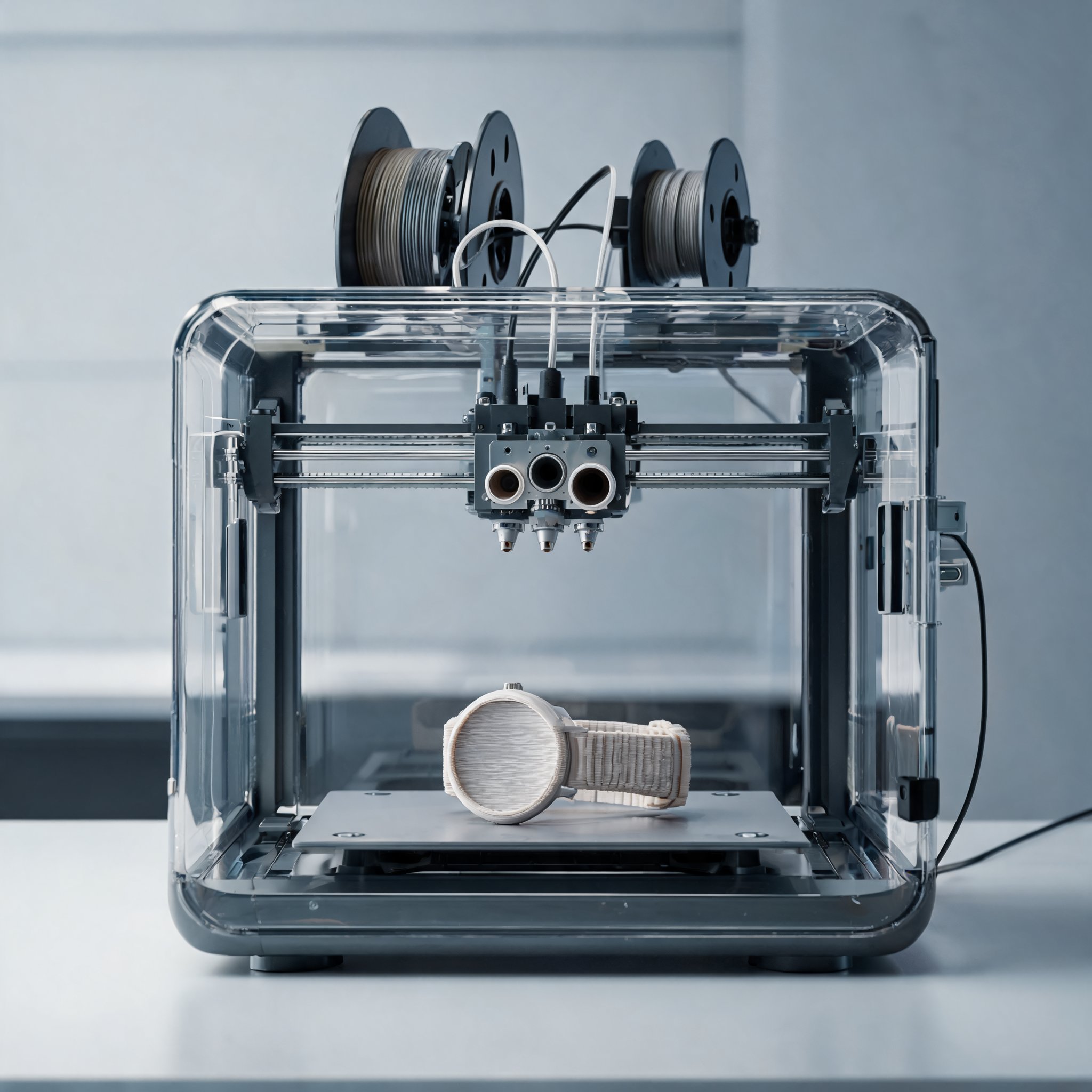
Bambu is continuing to preview its upcoming H3C 3D printer one feature at a time. After an earlier tease centered on multi-color printing, the company has now released an image and a short video suggesting the machine can combine different nozzle sizes and filament diameters within a single print job.
The preview uses a multi-component watch as its example, splitting the model into parts printed with different tooling:
- A 0.4 mm nozzle running 1.75 mm filament for the rigid watch case
- A 0.2 mm nozzle running 1.75 mm filament for the fine details
- A 0.4 mm nozzle running 2.85 mm filament for the soft strap, which may be TPU
Two points stand out. The first is the apparent addition of 2.85 mm filament support, aimed at soft and rubbery materials such as TPU. The second, and the more consequential, is the suggestion that 0.2 mm and 0.4 mm nozzles can be used in the same print.
A long-requested capability
Mixing nozzle sizes within one job is something users have long asked for on Bambu's dual-nozzle H2D and H2C machines, and likely the more recent X2D as well. On existing models, users cannot mix 0.4 mm and 0.2 mm nozzles in a single print; only one nozzle size can be selected, a limit tied to software rather than hardware alone.
An update to the teaser video shows watch components being printed in place as a single part with multiple nozzle and filament sizes, reinforcing that the feature is presented as a same-job capability rather than a series of separate prints.
It remains unclear whether mixed nozzle sizes would apply across all compatible Bambu printers or stay limited to the upcoming flagship H3C and the smaller P3C, which has not been formally announced. That distinction matters: it decides whether the capability is a selling point for new machines or an upgrade for existing owners. Bambu has not said which route it will take.