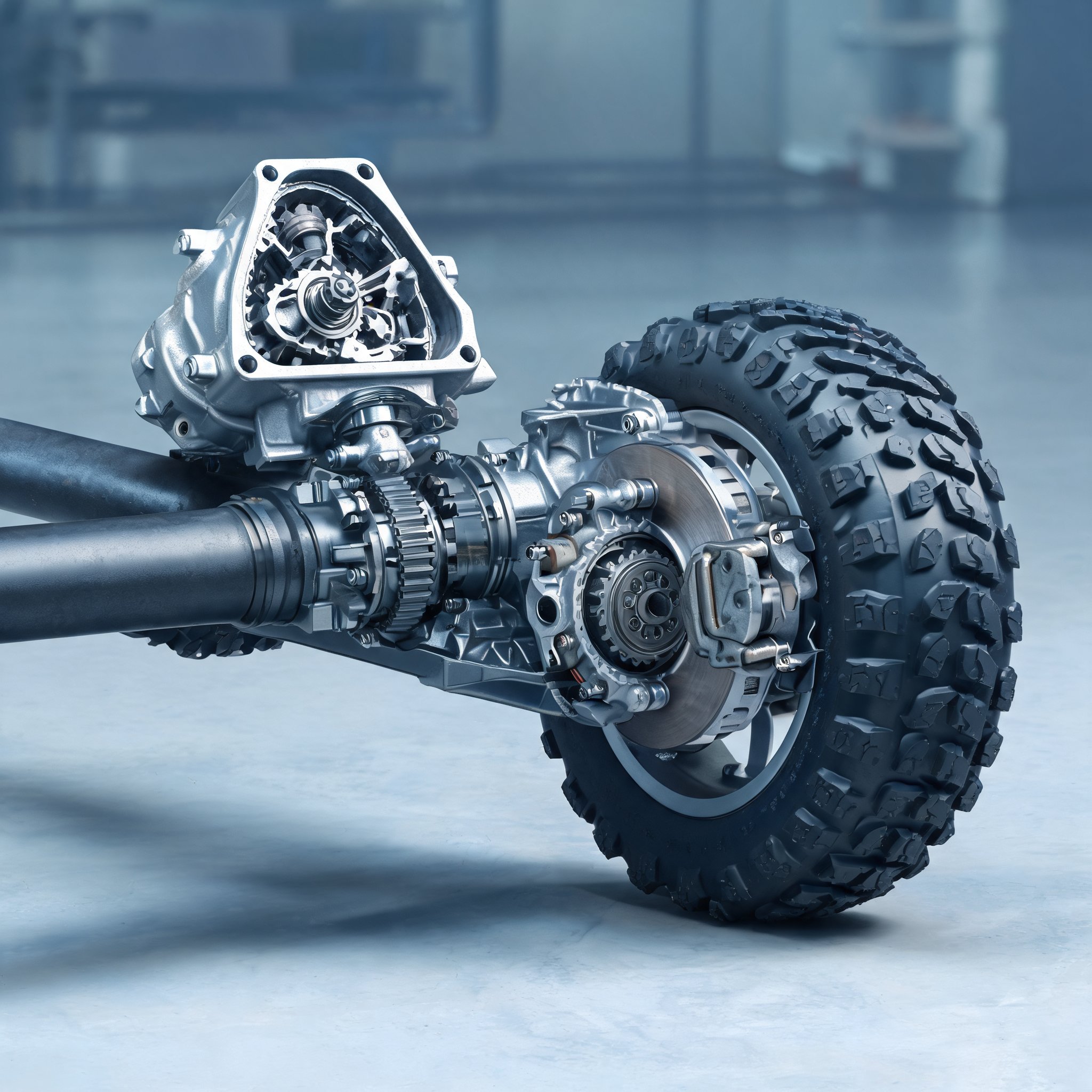
Portal axles are prized in hardcore off-roading because they lift a vehicle’s drivetrain without forcing the axle shafts to hang low. Instead of a conventional layout, they place a gear reduction behind each driven wheel, allowing the axle tube to sit higher and making room for tall tires. The drawback is cost: a typical set from a specialist supplier can run about $20,000. Zeph Gage’s Jeep project takes a different route, with a single rear portal axle built for roughly one-fifth of that figure.
Gage’s setup combines a Ford 9-inch axle housing, geared hubs from a Humvee and HMMWV portal adapters from Jesse Haines Fabrication. The Humvee-style portal uses two gears, which reverses the direction of the input shaft. To make that work with the Ford 9-inch, Gage flipped the differential upside down so the driveline turns in the correct direction. A Yukon Gear and Axle third member is then bolted to the differential, turning low-pinion parts into what functions as a high-pinion arrangement.
Clearance gains without giving up shock travel
The conversion is intended to add about six inches of clearance. It also preserves full shock travel, a packaging challenge that often complicates portal-axle swaps, and reduces stress on the differential. The expectation is that the resulting rear end should be effectively bulletproof, though that is a design claim rather than a tested result in the source material.
Gage deliberately left the front axle solid rather than installing portal hubs at both ends. He is following a trick used in remote-control rock crawlers: keeping the front conventional avoids the packaging constraints that arise when portal axles are added to a vehicle that never had them. It also means the build does not have to limit shock travel to fit the hardware, and the ride height does not rise to an absurd level. The layout is meant to be a best-of-both-worlds compromise.
This is not a bolt-on kit. Gage fabricated brackets, made custom-tapped plates and assembled a two-piece brake rotor with a Ford Fusion caliper. The Fusion caliper was chosen partly because it has an integrated electric emergency-brake solenoid, and partly for clearance. The finished XJ Jeep can drive over a five-gallon bucket and still have several inches of spare clearance. That matters because the rear end is less likely to hang up on obstacles that the front can steer around.
The project shows how much can be gained by rethinking the direction of existing parts rather than buying a complete portal-axle set. It also shows the limits of the approach: the rear-only layout depends on custom fabrication, careful brake packaging and a differential that has been turned upside down to suit the geared hubs. For a budget-minded off-roader, those trade-offs are the core of the idea.