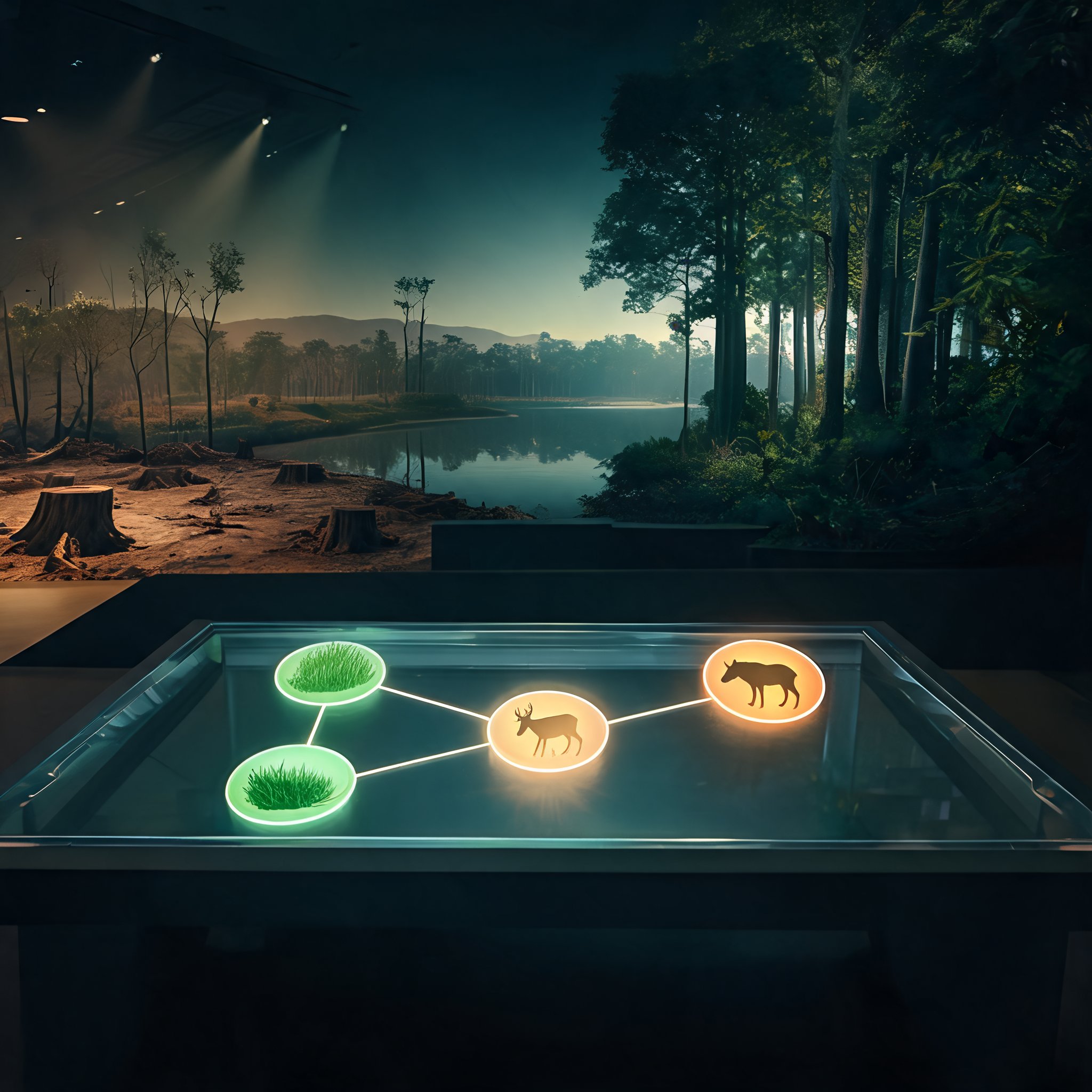
EcoWeb, an interactive exhibit from Lutra Interactive AB, turns food-web research into something visitors can take apart and rebuild. Users add or remove species from an ecosystem and watch what follows: taking out a predator can carry through to herbivores and plants, and losing one species can change others far away in the network.
The project rests on a straightforward argument. Biodiversity is not only a count of species in a place; it is also the pattern of interactions between them. Those connections, and especially the indirect effects that appear when an ecosystem changes, are hard to convey through conventional gallery displays, diagrams or lists of threatened species. EcoWeb sets out to make those processes visible and playable.
Built on published ecological data
The exhibit pairs simulation with real research rather than invented ecosystems. Its food webs are drawn from empirical data taken from published ecological studies, systematic literature reviews and records of where species occur. The underlying model includes both bottom-up and top-down effects, so a change can travel across the network instead of stopping at the species directly connected to it.
Complexity arrives in stages. Visitors begin with a three-species chain and test what happens when a species is added or removed. They then work with larger webs and with interactions of different types and strengths, before reaching full networks of more than 100 species and over 1,000 interactions. Individual species can be selected to reveal their connections, and threatened species can be explored. In the Swedish forest setting, visitors can move between recently cleared ground and old-growth forest to see how both species richness and the shape of the network shift.
Four ecosystems, one framework
Four contrasting systems are currently included: the Serengeti savanna, the Swedish boreal forest, an agricultural landscape and Lake Bolmen, one of Sweden's largest lakes. The same approach is applied in each case, while species, data and environmental pressures stay specific to the place.
EcoWeb was developed with scientists and educators and has moved past the prototype stage. It runs as a touchscreen installation at Universeum in Gothenburg, Curiosum in Umea and Visualization Center C in Norrkoping, and is also available online for WWF Sweden.
According to the developer, observations at these sites show visitors spending time examining species and their links, and sessions with school groups have prompted discussion and reasoning about extinction, indirect effects and trophic cascades. Those accounts describe how the exhibit is used rather than measured learning outcomes.
Framed around biodiversity loss
The work is positioned in the sustainability field, where biodiversity loss is a central concern. Its premise is that protecting biodiversity requires more than knowing that species are disappearing; people also need a sense of why particular species matter and how ecosystems rest on relationships between organisms. Letting visitors run their own experiments is intended to make that science concrete and memorable, and to link ecological research with public understanding of humanity's impact on nature.