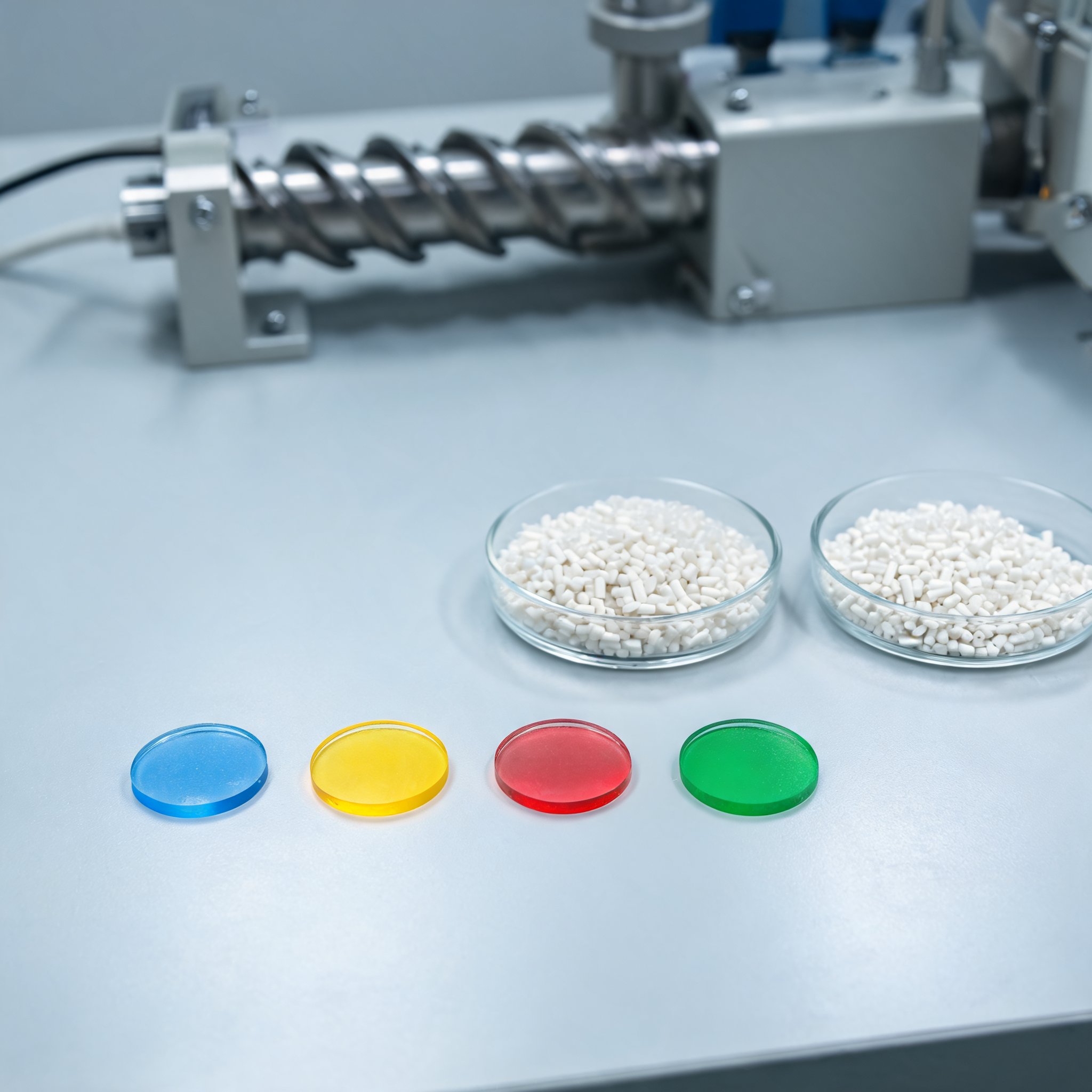
A study has tested four commercial natural pigments in color masterbatches for polylactic acid (PLA) and polybutylene succinate (PBS), two biodegradable polyesters. The pigments were blue spirulina, yellow curcumin, red beetroot and green chlorophyllin. The researchers wanted to know whether these colorants could endure industrial melt processing while retaining color, flow behavior and mechanical performance.
The masterbatches were produced by twin-screw extrusion. Formulations also contained titanium dioxide, calcium carbonate and stearic acid, added to support UV protection, pigment dispersion and processing. The concentrates were then diluted into the matching polymer at 2, 4 and 6 wt% and molded into test specimens by injection molding.
Thermal limits shape the process window
Heat was the first constraint. Thermogravimetric analysis put the degradation onset at about 229 °C for spirulina, 244 °C for curcumin, 258 °C for chlorophyllin and 267 °C for beetroot. PLA and PBS degrade at considerably higher temperatures, so the team selected extrusion profiles that melted each polymer while limiting exposure of the pigment.
Processing reached 145 °C for PBS and 190 °C for PLA. The twin-screw extruder ran at 65 rpm with a feed rate of 2 kg/h. Most pigment–polymer pairs processed successfully, but spirulina was the clear exception: it lost its blue color during PLA processing, so a blue PLA masterbatch could not be produced. PBS, processed at the lower temperature, retained enough pigment stability for compounding.
Flow and mechanical effects remain modest
From a rheological standpoint, the natural pigments caused only limited changes. Melt flow rate fell slightly after incorporation, pointing to a modest rise in melt viscosity. Neat PLA had an MFR of roughly 50 g/10 min, and its natural-pigment masterbatches stayed close to that value. PBS showed a similar small reduction. The researchers noted that compounders would see little value in a color system that demanded major changes to screw design, pressure settings or molding conditions; in this work, conventional twin-screw compounding and injection molding handled most formulations without major problems.
Tensile and impact tests covered the 2 to 6 wt% addition range. Neither PLA nor PBS showed significant losses in overall mechanical performance. PLA began with a Young’s modulus of about 1710 MPa and tensile strength of 65.6 MPa. PBS began at about 392 MPa and 34.5 MPa. The colored formulations remained close to those baselines. Impact strength stayed in a similar range, although individual pigments produced some variation.
Color fastness is the main barrier
Good extrusion results did not guarantee long-term color stability. After 50 hours of xenon-lamp exposure, most formulations had a color difference above ΔE* = 2, a level generally considered visually perceptible. The main exception was a PLA formulation containing 2 wt% green chlorophyllin masterbatch, which showed the highest photostability.
The study therefore points to UV stability as the largest obstacle to wider use. Packaging, consumer products, agricultural parts and outdoor applications may need additional stabilization, protective coatings or pigment modification before natural colors can compete with conventional systems over long service periods. The masterbatches also require further work on lightfastness and thermal stability.
Lower carbon footprint, but development continues
The environmental comparison favored the natural pigments under the study’s assumptions. One kilogram of curcumin pigment generated about 0.04 kg CO2-eq, compared with 18.65 kg CO2-eq for the inorganic green reference pigment. The natural-pigment masterbatches also used less electricity during extrusion and pelletizing.
Even so, the results do not establish a drop-in replacement for conventional colorants. They show that several natural colorants can be compounded into PLA and PBS on conventional equipment with limited changes in melt viscosity and mechanical performance. Improving color retention during processing and later service exposure remains the development priority.