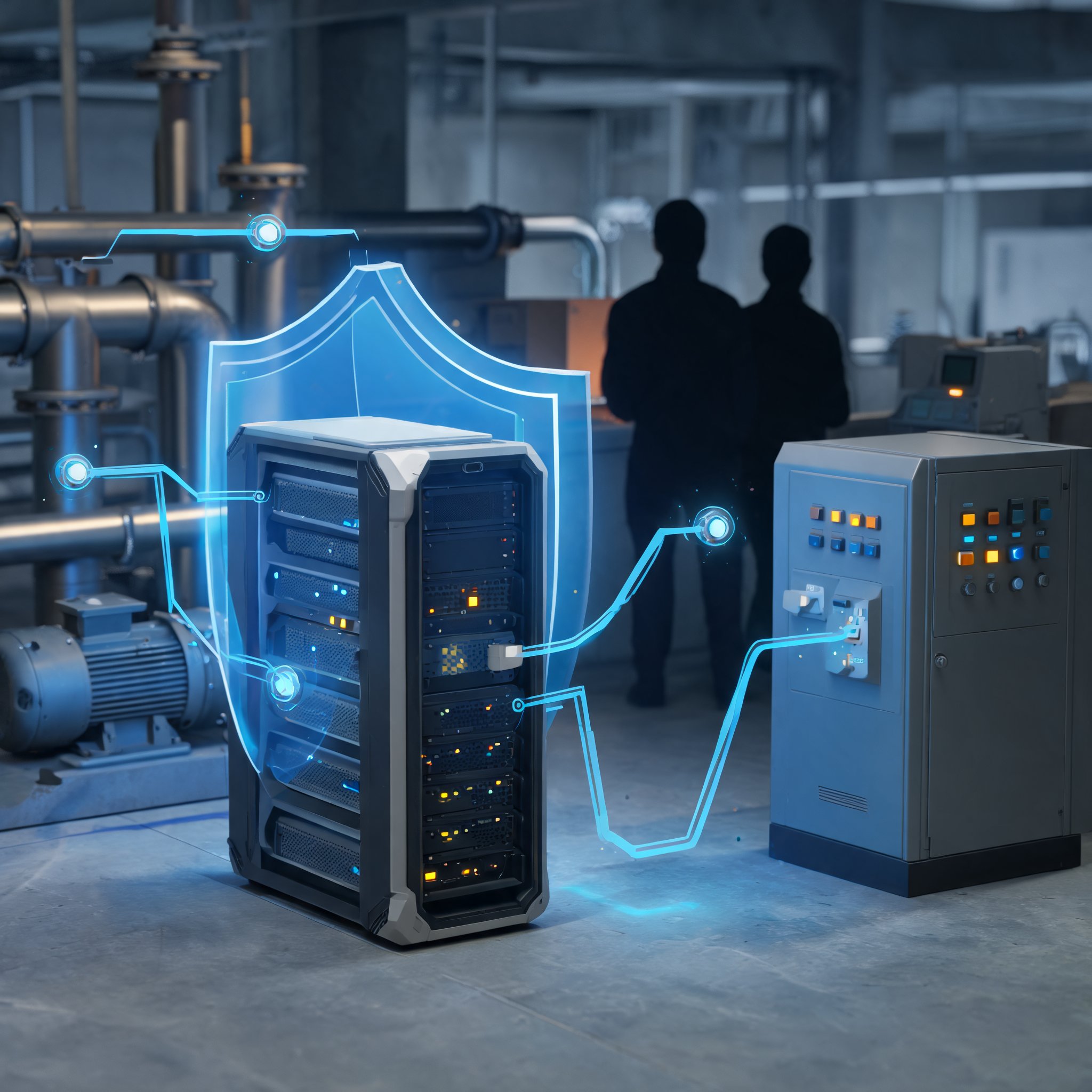
Schneider Electric has announced a strategic collaboration with NVIDIA and HPE aimed at accelerating Physical AI in process and heavy industries, where continuous operations place a premium on reliability, safety, cybersecurity and energy efficiency. The companies are introducing Industrial AI Agents at the Edge as an initial demonstration of their shared vision to embed intelligence closer to where industrial decisions are made.
The offering combines HPE Private Cloud AI, co-engineered with NVIDIA as part of the HPE AI Factory with NVIDIA portfolio, with Schneider Electric’s operational technology expertise. According to the companies, the combination is intended to let organizations deploy and scale AI applications at the industrial edge while retaining control over sensitive data, security and costs.
Addressing edge deployment barriers
Schneider Electric, NVIDIA and HPE said industrial organizations still face barriers when scaling AI across operational environments. The edge approach is designed to address three constraints:
- Data sovereignty: Operational data may be too valuable, sensitive or regulated to move beyond operational boundaries. HPE Private Cloud AI provides a secure foundation for deploying agents close to operations while maintaining control and compliance, the companies said.
- Cybersecurity: Greater connectivity can add risk across industrial and critical-infrastructure environments. Keeping and processing data near its source is intended to reduce the attack surface.
- AI consumption costs: As AI use grows, cloud-based inference, data transfer and token-related costs can rise. Deploying AI at the edge is positioned as a way to reduce some of those costs and give organizations more control over where workloads run.
First agents and management layer
Customers can deploy, manage and govern multiple Industrial AI Agents through Schneider Electric’s EcoStruxure Industrial Insights apps in a single environment. The company said this simplifies lifecycle management and security oversight while maintaining control of critical operations and infrastructure. The first agents focus on operational technology monitoring, cybersecurity and energy optimization.
- OT Monitoring Agents combine real-time operational data, equipment configurations, process topology, alarms, maintenance history and engineering context to assess the physical state of operations. They identify emerging issues, reason about likely operational impacts, recommend or initiate corrective actions, and verify whether an intervention delivers the expected physical outcome.
- Cybersecurity Agents correlate network activity, control-system behavior, asset configurations, operational events and process context to detect abnormal conditions. They assess potential operational impacts, recommend or execute response measures, and validate that systems return to a secure and stable state.
- Energy Optimization Agents integrate process data, energy-consumption patterns, equipment performance, operating conditions and production requirements to understand energy use. They identify optimization opportunities, recommend or implement adjustments, and verify the resulting impact on energy efficiency, operational performance and sustainability outcomes.
CMPC Chile provides operational base
The foundation for the next step is already in use at CMPC Chile, part of Empresas CMPC S.A., described as one of Latin America’s largest pulp, paper and packaging producers. For three years, CMPC Chile has used Schneider Electric’s OTMS in production to monitor the health and availability of control systems across continuous pulp and paper operations.
OTMS gives CMPC teams a unified view of control systems, servers, workstations and switches, helping specialists identify emerging issues earlier, diagnose problems faster and set clearer maintenance priorities. The companies said this deployment demonstrates OTMS as a control-system monitoring solution and provides an operational foundation for future Industrial AI Agents, with the potential to speed investigation and decision-making while keeping people in control of critical actions.
Company positions
Gwenaelle Huet, Schneider Electric’s executive vice president of industrial automation, said the next wave of industrial innovation will come from intelligence embedded in operations. She said that while attention often centers on autonomous machines, Schneider sees an opportunity to apply Physical AI to the industrial systems that power critical industries. The collaboration, she said, combines automation, AI and edge-computing expertise to turn operational data into action.
Sri Kodali of NVIDIA said industrial operations generate large data volumes, but turning that data into action remains a major challenge. He said combining NVIDIA Nemotron open AI models and HPE Private Cloud AI with Schneider’s expertise and OTMS platform allows agents to monitor, reason and optimize operations in real time. Alexia Clements of HPE said the approach helps customers expand AI across facilities while protecting sensitive data and critical systems.
Matías Jory of CMPC said OTMS has improved visibility into control-system health and availability over three years, and that early issue identification is critical in continuous operations. He sees potential for AI Agents to help specialists investigate faster while people retain control of critical decisions.
The companies said the collaboration is intended to create a foundation for industrial operations in which intelligent systems continuously monitor, reason and optimize performance. Over time, they said, these capabilities could help automate more of the automation layer, enabling safer, more efficient and increasingly autonomous operations across process industries.